Inspired by the work of Garik Galstyan (lecturer and researcher at the University of Lille).
“I have three homelands: I was born in Georgia, I worked in Ukraine and I will die in Armenia.”1 — Sergei Parajanov
An affront to socialist realism
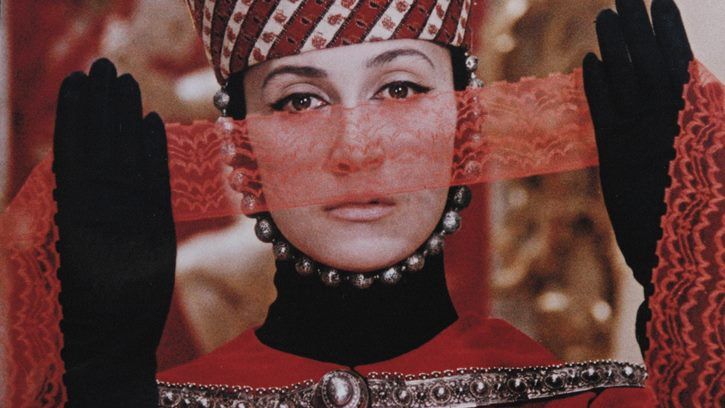
Made in 1969 under the Soviet regime, The Color of Pomegranates retraces the life of the Armenian poet Sayat-Nova. Against the official dogma, which sought to homogenise the cultures of the USSR through art, Parajanov chose to put Armenian memory, faith and aesthetics on display.
By weaving in sacred music (sharakans), ancient manuscripts and medieval iconography, he made a genuinely political statement. Accused of “nationalism”, the film was censored and re-edited by Moscow.2
From biblical symbol to collective memory
In Parajanov’s visual language, every object is a symbol. The pomegranate, a fruit rooted in Armenian architecture and miniatures, embodies fertility but also martyrdom.
The famous scene of pomegranate juice spreading across a white cloth evokes the wounds of Armenian history and the genocide of 1915. Through this chromatic prism, Parajanov turns suffering into a symbol of national resilience.
Safeguarding traditional crafts
The film acts as a living archive: carpet weavers, the making of lavash, the washing of wool in Tiflis and the carving of khachkars (stone crosses now recognised by UNESCO)3 are all immortalised in it.
Parajanov did not use artificial sets, but authentic objects lent by museums and local people. He thus created a true “museum on celluloid”, paying tribute to the folk art and craftspeople of the Caucasus.
The film’s impact reaches far beyond the Caucasus. Admired by figures of world cinema such as Martin Scorsese and Atom Egoyan,4 Parajanov’s poetic, painterly style continues to feed global visual culture.
Culture, the bedrock of sovereignty
To celebrate Armenia’s independence is also to recall what keeps a nation standing beyond geopolitical crises. As the filmmaker wrote, what mattered most was passing knowledge and memory on to future generations.
In the face of today’s challenges, Parajanov’s masterpiece is a reminder that preserving heritage and making it shine remain the fundamental guarantees of a people’s identity.
From haute couture shows to international pop videos (notably Lady Gaga’s 911)5, Parajanov’s aesthetic proves that cultural influence is one of the most enduring weapons for making a nation exist on the world stage.
Notes
-
A 1988 quotation, cited notably by Armenpress, “Moscow opens exhibition devoted to 90th birth anniversary of Sergei Parajanov”. ↩
-
Jonathan Rosenbaum, “The Color of Pomegranates: The Director’s Cut”, 1993 (on the version re-edited by Sergei Yutkevich for distribution outside Armenia). ↩
-
UNESCO, “Armenian cross-stones art. Symbolism and craftsmanship of Khachkars”, inscribed in 2010 on the Representative List of the Intangible Cultural Heritage of Humanity. ↩
-
The Film Foundation, 2014 annual report (restoration of the film carried out with the Cineteca di Bologna, presented at Cannes in 2014); The Moscow Times, “Filmmaker Zara Jian celebrates the spirit of Sergei Parajanov in Venice”, 2024 (Atom Egoyan’s testimony). ↩
-
The Moscow Times, “Lady Gaga’s new video is an ode to a Soviet film classic”, 23 September 2020; Armenpress, “Lady Gaga’s 911 music video inspired by classic Armenian cinema masterpiece”. ↩