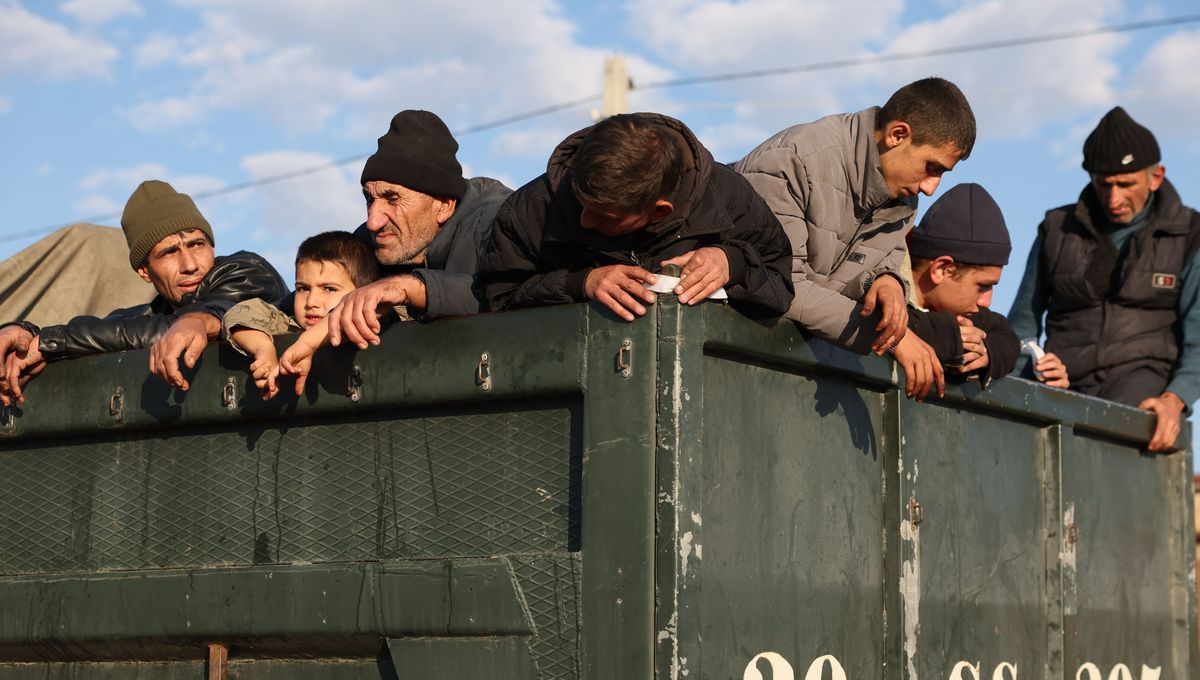
In September 2023, more than 100,000 Armenians, almost the entire population, left Nagorno-Karabakh (Artsakh in Armenian) after the Azerbaijani offensive and a nine-month blockade of the Lachin corridor, which had severely weakened the population.1 The disappearance of the Republic of Artsakh put an end to three decades of independent political existence on a territory that belonged, de jure, to Azerbaijan.2
A reshaping of the regional balance of power
This event goes beyond a humanitarian crisis: it reveals a profound geopolitical reshaping of the South Caucasus. Since the 2020 war, Azerbaijan has established itself as the main power in the South Caucasus. Turkish military support and Baku’s energy revenues strengthen the Azerbaijan-Turkey axis. Meanwhile, Russia’s inaction in the face of Azerbaijani incursions into Armenian territory exposes the weakening of Moscow’s security guarantees to Armenia.3 Yerevan is now seeking to diversify its alliances towards Europe.
Armenia, between isolation and dependence
Armenia remains marked by the “myth of the foreign protector”. According to Tigran Yegavian in Le Courrier d’Erevan, it is “a conviction rooted in Armenian culture that a great power will always end up coming to Armenia’s rescue”.
The loss of Artsakh weakens Armenia’s regional security position and reveals a country more vulnerable militarily, as shown by the incursions into its national territory from 2022 onwards.4
Minoritisation and the redefinition of the national body
While, in the early days of the exodus, the whole Armenian community, national and transnational, mobilised widely to support the refugees, a weariness in their reception in Armenia has been observed in recent months. As the refugees’ resettlement drags on, tensions are emerging in the public and media sphere. In the run-up to the elections, some pro-government media describe the refugees as “deserters” or “ingrates”.5
The media are playing on a rhetoric very common in times of crisis, which creates the illusion that the mass arrival of displaced people would worsen the economic and social tensions of an already fragile state. This narrative reinforces the process of minoritisation already under way, but does not reflect the general feeling of the population, which remains supportive.
The exodus does not merely produce a population displacement: it also helps to redraw the symbolic boundaries of the Armenian community, between “real” Armenians and “the others”.
Moving beyond the paradigm of vulnerability?
Yet reducing displaced people to a passive figure renders their capacity for action invisible. Despite the violence of the displacement, many practices of resistance and adaptation are emerging among the refugees.
We can speak of “agency”, a notion that refers to people’s capacity to act autonomously in their displacement, despite the political, economic, social or administrative constraints they face.
Thus, despite the fear and the climate of extreme tension in which the entire population of Artsakh found itself on the road to exile, leaving also expressed a will to retain some form of control, even within a constrained margin of existence.
Memory and resistance
Among these practices of resistance, some displaced people refuse to give up their Artsakh citizenship in order to preserve a political and memorial distinctiveness; as a result, they will not be able to vote in the upcoming elections.6 Even if this practice is also explained by the fact that Armenian citizenship is not necessary in everyday life, it runs counter to the injunctions to integrate that minoritise the existence of Artsakh.
This question reveals a deeper tension: the Armenians of Artsakh were fully part of the national community until the loss of their territory, before seeing their administrative and legal status in Armenia gradually weakened, producing a kind of symbolic denationalisation.7
Hate speech and discrimination against the Armenians of Artsakh are not new, but they have intensified since more than 10,000 people from Artsakh and Armenia rallied on 29 March.8 On 14 April 2025, the protesters filed an official complaint demanding action against what they describe as systematic discrimination.9
The forcibly displaced continue to make their voices heard in public, notably through several rallies organised to put an end to anti-Artsakh propaganda. Also rejecting strategies of erasure or self-concealment, one testimony gathered by EVN Report says:
“Before, when I came to Yerevan, I made an effort to speak literary Armenian, not the Artsakh dialect. I don’t do that any more. I am proud to come from Artsakh and I don’t want to hide my suffering. It’s not so that people pity me; I simply want everyone to remember the hardships endured and the challenges we take on to rebuild our lives.”
Conclusion
The exodus thus reveals a central tension: while the refugees suffer a major loss of territorial and political power, they are also developing strategies to preserve a social and collective existence. Studying the post-Artsakh period shows how individual practices of resistance can become forms of collective engagement.
The memory of Artsakh lives on as a claimed space and as a collective identity.
Notes
-
Human Rights Watch, “Driven by Fear from Nagorno-Karabakh”, 17 October 2023; EVN Report, “News Watch Artsakh: September 2023” (100,632 displaced persons registered in Armenia). ↩
-
Eurasianet, “The Nagorno-Karabakh Republic: The life and death of an unrecognized state”. ↩
-
EVN Report, “The 2022 Azerbaijani Incursion Into Armenia: Events and Aftermath”; Eurasianet, “Armenia further downgrades participation in CSTO”. ↩
-
EVN Report, “Azerbaijan Launches Large-Scale Attack Against Armenia”, 13 September 2022. ↩
-
CivilNet, “State-Sponsored Hate: How Armenia’s Ruling Party and Pro-Government Media Target Karabakh Refugees”; OC Media, “Nagorno-Karabakh Armenians subjected to hate speech following their ongoing protests”. ↩
-
CivilNet, “Two years after exodus, Karabakh residents in Armenia navigate life without political voice”; Eurasianet, “Armenia to offer refugee status to displaced Karabakhis”. ↩
-
CivilNet, “Karabakh Armenians hold passports yet lack citizenship”. ↩
-
Azatutyun (RFE/RL), “Thousands Of Karabakh Armenians Protest In Yerevan”, 29 March 2025. ↩
-
Azatutyun (RFE/RL), “Karabakh Activists Protest Against “Hate Speech” In Armenia”, 14 April 2025. ↩