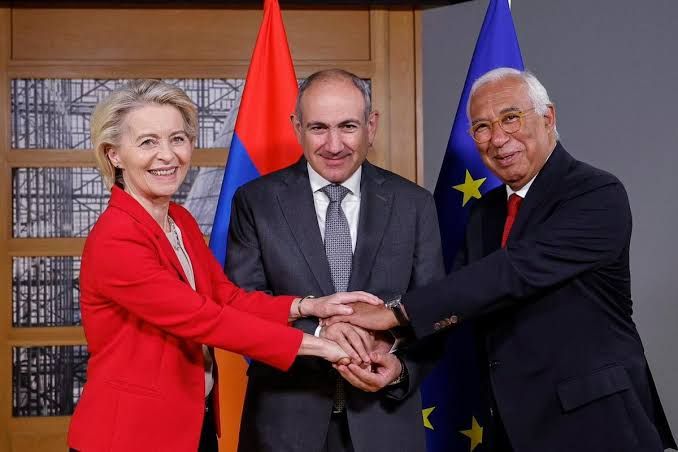
An unprecedented summit
The EU-Armenia summit of 4 and 5 May 2026 in Yerevan is a first in the history of this relationship. It brings together key leaders such as the President of the European Council, António Costa, and the President of the European Commission, Ursula von der Leyen, hosted by the Armenian Prime Minister, Nikol Pashinyan.1
The event coincides with the meeting of the European Political Community (EPC), which brings together nearly 50 European states, a sign of Yerevan’s strategic importance for European interests.2 It comes one month before Armenia’s parliamentary elections of 7 June. In this context, the EU has launched a civilian mission against foreign interference and Russian disinformation threats.3
The emergence of the Yerevan-Brussels axis is part of a regional configuration full of contradictions. While the European Union now presents itself as a leading political supporter of Armenia, it remains tied to Azerbaijan by gas imperatives: its imports have jumped by more than 50% since 2021, reaching 12.5 billion cubic metres in 2025.4
This strategic dependence, illustrated by Ursula von der Leyen calling the Baku regime a “trustworthy partner” when the gas deal was signed in July 20225, puts Brussels in an ambivalent position: that of economic customer of a state responsible for the ethnic cleansing of Artsakh, while also claiming to protect Armenia’s democratic aspirations.
Despite this paradox, Armenia is pursuing its pivot to the West with determination, seeking from the Twenty-Seven the guarantees of security and sovereignty that Moscow is no longer able to offer.
Franco-Armenian cooperation
From 3 to 5 May, Emmanuel Macron is making a bilateral visit to Armenia alongside the summit. The French president and Nikol Pashinyan are due to sign a strategic partnership agreement strengthening defence cooperation, including the delivery of French radars.6 There are also agreements on transport, with potential prospects for Airbus according to the Élysée, and on the construction of a tunnel on Armenia’s north-south highway, which is expected to be awarded to the French companies Vinci Construction and Razel-Bec.7 The Sisian-Kajaran section of this road involves €858 million for the construction of 9 tunnels and 27 bridges;8 it will cut several hours off the journey between Yerevan and the Iranian border.
Turkish participation
Initially invited by the European Political Community, Recep Tayyip Erdoğan will not attend the summit after all: Turkish Vice-President Cevdet Yılmaz is travelling to Yerevan instead.9 This is the highest-ranking visit by a Turkish official to Armenia since that of President Abdullah Gül in 2008, in a broader context of normalisation between the two states, illustrated by the launch of Turkish Airlines flights to Armenia since mid-March 2026.10
Deepening economic relations and connectivity
The summit aims in particular to develop energy, transport and digital infrastructure, in order to facilitate trade and Armenia’s integration into European networks. It relies on significant funding: since 2024, the EU has mobilised €270 million through a resilience plan to support Armenian businesses and economic reforms, as part of the Global Gateway strategy.11 In total, the European investments expected under Global Gateway amount to €2.5 billion, to improve the country’s export capacity and reduce its dependence on Russia.12
A central issue: peace and stability in the South Caucasus
The EU is putting mechanisms in place to strengthen regional security and stability. It operates through civilian missions such as EUMA, an observation mission tasked with monitoring the Armenian-Azerbaijani border, whose operational headquarters is in Yeghegnadzor, in Vayots Dzor.
European engagement now extends to defence, with the allocation in January 2026 of €20 million through the European Peace Facility (EPF).13 This allocation was, however, held up by Hungary’s repeated obstruction: through this systematic veto, Viktor Orbán aligned Budapest’s position with Baku’s interests, in effect delaying Armenia’s military restructuring.14
The continuing Armenian-Russian rupture?
Since the break-up of the Soviet bloc, Armenia’s trajectory has been shaped by a profound asymmetry with Russia, revealing a form of vassalisation that extends to all the levers of sovereignty. Inherited from earlier imperial structures, it shows first in membership of the Eurasian Economic Union (EAEU), a space in which Moscow imposes its own regulatory and trade orientations.
This framework of dependence extends to defence, as shown by the presence of Russia’s 102nd military base in Gyumri. As the main arms supplier until 2022 and the pivot of the Collective Security Treaty Organisation (CSTO), Russia long acted as the sole guarantor of the Armenian state’s survival. Finally, until the Velvet Revolution of 2018, this dependence was also marked by a socio-political osmosis between the local elite and the decision-making centres in Moscow.
Since 2022, this paradigm has been eroding: Yerevan is diversifying its diplomacy in the face of Moscow’s passivity before Azerbaijani offensives. This pivot resulted in 2024 in the freezing of Armenia’s participation in the CSTO15 and in a clear rapprochement with the EU. However, on 1 April, Vladimir Putin reminded Nikol Pashinyan of the institutional incompatibility between the EU and the EAEU.16
The road to European integration
Armenia’s European integration is progressing pragmatically: in March 2025, the Armenian Parliament adopted a law launching the accession process.17 This dynamic is not new: since signing the Comprehensive and Enhanced Partnership Agreement (CEPA) with the EU in 2017, the country has gradually been aligning its standards with those of the European market. This process is reflected in rising trade: the EU now accounts for around 7 to 10% of Armenia’s foreign trade.18
The rapprochement is also visible in talks on visa liberalisation since 2024.19 Armenia is seeking to diversify its alliances by moving closer to the EU, while maintaining important ties with Russia. Rapid accession seems unlikely, but this dynamic reflects a genuine will for long-term rapprochement: according to an International Republican Institute (IRI) poll of February 2026, 72% of Armenians are in favour of joining the European Union.20
Notes
-
Council of the European Union, “First ever EU-Armenia summit to take place on 4 and 5 May 2026”, 26 March 2026. ↩
-
OC Media, “Armenia hosts European Political Community summit”, May 2026. ↩
-
European Commission, “EU and Armenia deepen their relations in a first Summit in Yerevan”, May 2026. ↩
-
Eurasianet, “Azerbaijan’s energy relations with EU experiencing bout of uncertainty” (European Commission figures: 12.5 billion m³ in 2025, more than 50% up on 2021). ↩
-
The Brussels Times, “EU plans to double gas imports from “trustworthy partner” Azerbaijan”, 18 July 2022. ↩
-
CivilNet, “Macron’s Armenia visit highlights the opportunities and limits of European engagement”, May 2026; Armenpress, “Pashinyan, Macron sign declaration on Armenia–France strategic partnership”, 5 May 2026. ↩
-
OC Media, “Armenia signs agreements with EU and France”, May 2026. ↩
-
Armenpress, “Sisian–Kajaran road project to shorten route by 54 km”, June 2026; Armenpress, “Armenia to take €236 million loan from EIB for Sisian-Kajaran road” (€708 million in loans and €150 million from the Armenian state). ↩
-
Armenpress, “Turkish Vice President arrives in Armenia for EPC Summit”, 4 May 2026. ↩
-
Armenpress, “Turkish Airlines starts Istanbul–Yerevan flights”, 11 March 2026. ↩
-
European External Action Service, “A resilience and growth plan for Armenia”, April 2024. ↩
-
Armenpress, “EU investments in Armenia to reach €2.5 billion”. This €2.5 billion corresponds to the investments expected under Global Gateway, not to the resilience plan alone. ↩
-
Armenpress, “Armenia to receive €20 million European Peace Facility aid package, PM confirms”. ↩
-
OC Media, “Hungary blocking non-lethal military aid to Armenia over lack of support to Azerbaijan”. ↩
-
Armenpress, “Our interest in the CSTO has run its course, says Nikol Pashinyan” (recalling the freeze of February 2024). ↩
-
OC Media, “Pashinyan and Putin clash over Armenia’s EU aspirations, agree to continue talks in Moscow”. ↩
-
Armenpress, “Armenian parliament adopts EU bill”, 26 March 2025. ↩
-
CivilNet, “By the numbers: Armenia’s prospects under new EU tariff relief” (the EU accounted for 8% of Armenia’s exports in 2025). ↩
-
Armenpress, ““Historic step”: EU hands over Armenia Visa Liberalization Action Plan”. ↩
-
International Republican Institute, “Public Opinion Survey: Residents of Armenia, February 2026”, survey conducted 3-13 February 2026. ↩