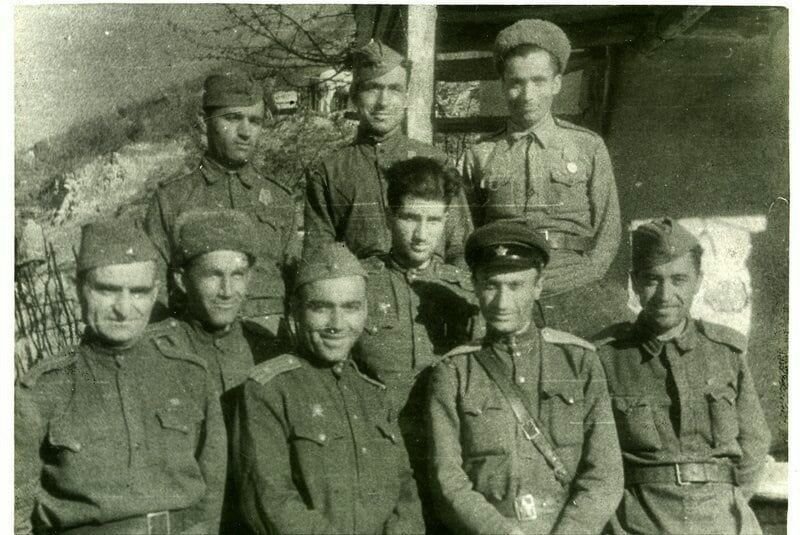
9 May 2026 marked the 81st anniversary of the surrender of Nazi Germany. Having attended the 2025 parade, Nikol Pashinyan did not travel to Moscow this year, citing the election campaign, breaking with the traditional commemorations of the Allied victory of 1945.1 Once a pillar of “Soviet brotherhood”, the memory of victory is today an ideological battlefield on which Armenia’s sovereignty and its positioning between Moscow and the West are at stake.
The break is all the more symbolic given that the Armenian Soviet Socialist Republic (SSR) was a pillar of the Soviet victory: some 300,000 of its inhabitants, one in five, were mobilised (more than 500,000 Armenians from across the USSR in total), and nearly half of them fell at the front.2 On top of the financial and human sacrifices of the diaspora came major industrial and scientific support.
The Soviet rampart: the Armenian people’s last shield
During the Second World War, the Armenian SSR faced a double threat: aggression by the Wehrmacht and the spectre of a Turkish invasion. In 1942, after the signing of the non-aggression pact between Turkey and Nazi Germany, Ankara massed 26 divisions on the Armenian border.3
This threat strengthened Armenian patriotic zeal: fighting for the Red Army meant preventing the fall of the Soviet rampart, whose loss would have meant the physical end of Armenia and the return of the spectre of 1915. Support for the USSR, beyond any attachment to communism, was an imperative of national security.
The smallest of the USSR’s fifteen republics (29,800 km²), Armenia had one of the highest mobilisation rates: one citizen in five sent to the front.4 In the summer of 1942, the German breakthrough in the Caucasus seemed unstoppable: facing the US energy embargo and British control of the Middle East, Hitler wanted to seize the oil wells of Baku.
To galvanise patriotic sentiment, the Red Army set up so-called “national” rifle divisions, made up mostly of Armenians. These units travelled thousands of kilometres, from the Caucasus to the heart of the Third Reich:
- 76th Division: formed as early as 1922, it fought from Stalingrad to Belarus;
- 89th (Taman) Division: the only national division to take part in the Battle of Berlin, where it fought its way into the Reichstag;5
- 390th Division: engaged in the fierce fighting on the Kerch Peninsula, in Crimea;
- 408th Division: took part in the defence of Novorossiysk and ended the war on the Elbe;
- 409th Division: guarded the Turkish border, then took part in the liberation of Budapest and Vienna.
In May 1945, soldiers of the Taman Division celebrated the fall of Nazism by dancing the kochari, a traditional Armenian dance, at the foot of the ruined Reichstag.6
The role of Armenian officers
Admiral Ivan Isakov (born Hovhannes Ter-Isahakian; like many Armenians of the Russian Empire, his name was Russified), chief of staff of the Soviet Navy, was the architect of the defence of Leningrad and the linchpin of logistics in the Baltic and Black Seas.7
Hamazasp Babadzhanian, the embodiment of Soviet armoured power, distinguished himself from Kursk, the largest tank battle in history, to the street fighting in Berlin, where he played a major role in the final assaults on the centres of Nazi power.
Marshal Hovhannes Bagramyan was the architect of Operation Bagration in 1944, decisive for the final victory. One of the rare non-Slavic commanders to lead an entire front, his boldness earned him the title of Hero of the Soviet Union twice.8
The David of Sassoun tank column
The diaspora organised a massive fundraising drive to finance a column of tanks to reinforce the Red Army. This cross-party initiative played a crucial unifying role within the diaspora, transcending the historical divisions between the Dashnak party (often critical of the USSR) and pro-Soviet movements.
The collection made it possible to equip the 119th Independent Tank Regiment.9 Its T-34 tanks bore, in Armenian letters, the name of David of Sassoun, hero of the medieval epic, sealing the union between the crushing of Nazism and the defence of national culture.
Yerevan’s industrial and scientific boom
The war also acted as a powerful technological and industrial catalyst for Armenia. With Russian and Ukrainian industrial centres under occupation, the USSR relocated or developed strategic production capacity in Armenia: more than 30 factories and 110 workshops were created during the conflict.
Mobilisation turned Armenia’s productive apparatus into a nerve centre of strategic chemistry and aeronautics, notably through Factory No. 447.10 This technological leap foreshadowed the future Soviet “Silicon Valley”: at its peak, the republic produced nearly 40% of the mainframe computers used by the Soviet military.11 The MiG-3 fighter, although not built in Armenia, was designed by the Mikoyan-Gurevich design bureau, co-founded by the Armenian engineer Artem Mikoyan.
Expertise in space optics and military lasers carries this legacy forward today, while 9 May has settled into a “triple victory”: it now brings together the fall of Nazism, the capture of Shushi in 1992 and the birth of the Artsakh army.12
Notes
-
Armenpress, “Pashinyan to skip Victory Day parade in Moscow”, May 2026; OC Media, “Pashinyan attends Victory Day parade in Moscow for the second time”, May 2025. ↩
-
Azatutyun (RFE/RL), “Armenian Troops March In Russian WW2 Parade” (around 300,000 inhabitants of Soviet Armenia and more than 200,000 Armenians from other republics mobilised, nearly half of whom were killed). ↩
-
The figure varies between sources (from 20 to 26 divisions). See Foreign Relations of the United States, 1942, vol. IV, “Clarification of statement by Ambassador MacMurray regarding Turkish-Soviet relations”. ↩
-
Azatutyun (RFE/RL), “Armenia Marks Soviet Victory In WW2”. ↩
-
History Museum of Armenia, “In the origins of the army, part II”. ↩
-
Armedia, “Armenians Danced “Kochari” at the Walls of Reichstag in Berlin”. ↩
-
Armenpress, “Generals of the Victory”. ↩
-
Armenpress, “Generals of the Victory”. ↩
-
Rossiyskaya Gazeta, “The ‘David of Sassoun’ column: how Armenians gave the Red Army 21 tanks” (in Russian), 20 March 2020. ↩
-
EVN Report, “Armenia: The Silicon Valley of the Soviet Union”. ↩
-
Eurasianet, “Fresh from revolution, Armenia’s tech industry has high expectations” (nearly 40% of the mainframe computers used by the Soviet military). ↩
-
Armenpress, “May triple holiday”. ↩