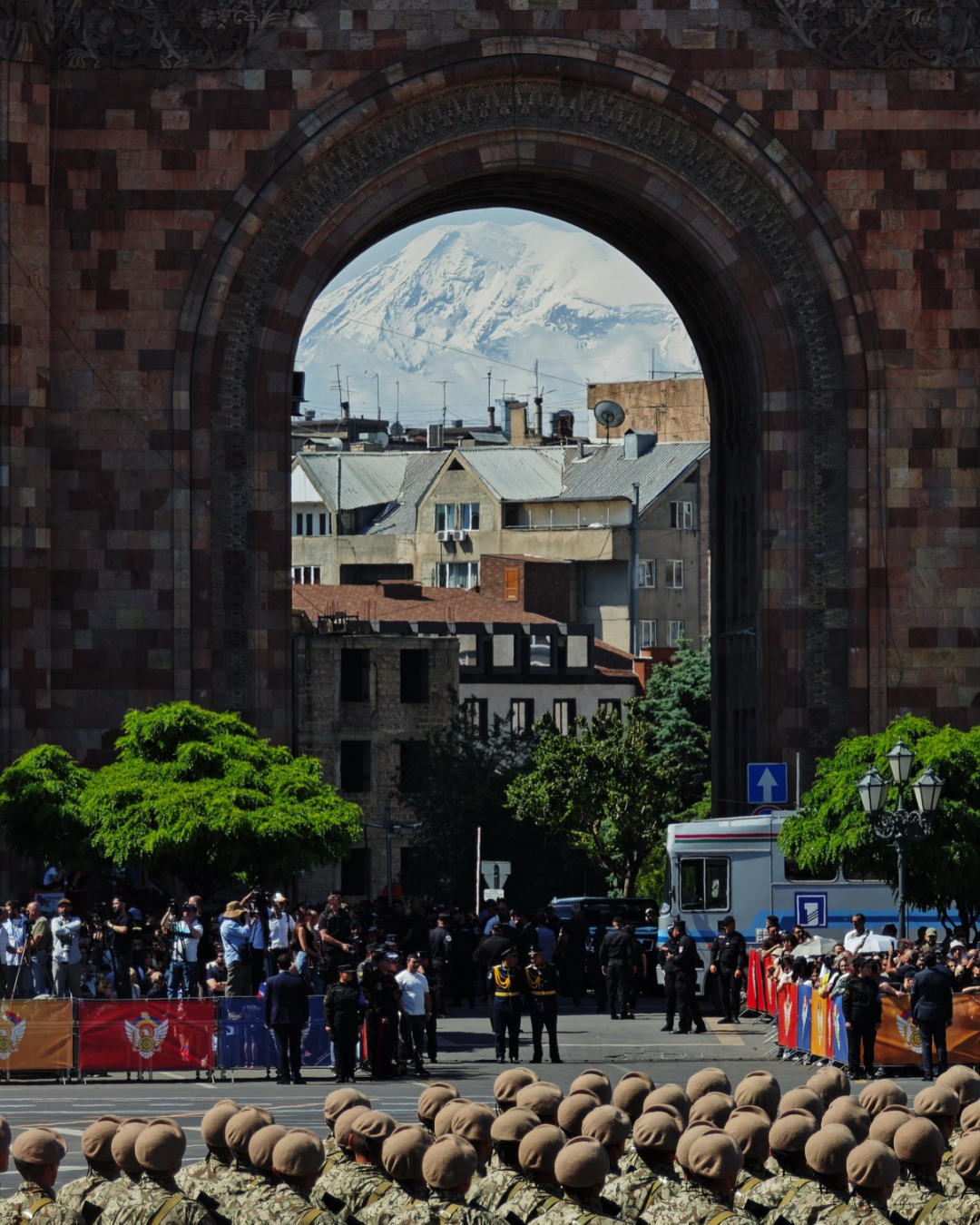
The military parade of 28 May 2026 in Yerevan formalised the structural reorganisation of the Republic of Armenia’s defence apparatus, with the government choosing to display mainly equipment acquired since the debacle of 2020.1
With elections approaching, the government is using the military to respond to the anxieties of Armenian society: according to IRI data (May 2026), 73% of respondents identify Azerbaijan as the main threat, and 58% Turkey.2
Yerevan is carrying out a historic transformation here, breaking its dependence on Russia in favour of diversified purchases worldwide and the growth of local industry. However, the real challenge no longer lies in accumulating new technologies, but in Yerevan’s ability to make these heterogeneous systems work together while modernising the training of its soldiers for 21st-century warfare.
Russian anaemia and hyper-diversification
Moscow’s blocking of $400 million in arms contracts3 forced Yerevan to cut its military dependence on Russia from 94% to less than 10%.4 This rupture gave rise to a strategy of hyper-diversification that responds as much to tactical urgency as to geopolitical calculation:
- The Indian anchor: by investing $1.5 billion in New Delhi’s heavy artillery and anti-aircraft missiles,5 Armenia is tying itself to a global power to counter the Pakistan-Turkey-Azerbaijan axis.
- The French axis: the purchase of high-precision GM200 radars and CAESAR guns6 brings qualitative technical superiority, while breaking the country’s diplomatic isolation by anchoring it in Europe.
- The axis of rival powers (China, Iran, the United States): by integrating Chinese drones, Iranian counter-drone systems and American reconnaissance tools,7 Yerevan is trying to turn its geographical vulnerability into a space of technical and geopolitical balance.
The rise of the military-industrial complex: autonomy through innovation
To make up for its numerical inferiority against its neighbours, Armenia is relying on its dynamic civilian high-tech sector, boosted by $450 million in state investment.8 This industrial surge, which aims eventually to meet 25 to 30% of the army’s needs through domestic production,9 is particularly visible in the development of loitering munitions (drones). As an example of this technological effort, the DDS-10K drone, produced by the company Davaro, was specifically designed to contest enemy air superiority and neutralise systems such as the Bayraktar TB2.10 Combining a reduced radar signature with targeted interception capabilities, this home-grown drone hunter gives the general staff a direct asymmetric response.
Towards a doctrinal transformation…
The disaster of 2020 highlighted what Colonel Z. Amirkhanyan calls a “failure to innovate”11: the general staff’s inability to break free from the static post-Soviet model of attrition.
In response, the “Army Transformation 2024-2035” plan12 is betting on the internationalisation of skills, notably through French expertise. The central goal is to adopt NATO standards, which means integrating Armenian officers into the Saint-Cyr military academy13 and adopting the 155 mm calibre through the CAESAR gun. This technological and intellectual transfer allows the general staff to break with the doctrinal rigidity inherited from the USSR in favour of mobile manoeuvre warfare, the only approach capable of optimising the responsiveness and survival of forces facing a numerically superior enemy.
… with clear limits
Despite a budget that has nearly tripled since 2020 (from $634 million to $1.7 billion in 2025)14, Leonid Nersisyan (APRI Armenia)15 points out that Yerevan’s success now depends on operational integration.
While diversification (India, France, the United States) breaks dependence, it poses a major technical challenge: the heterogeneity of calibres, software and maintenance. The central issue is C2 (command and control). To avoid inefficiency, French radars must communicate in real time with Indian missiles, and domestic drones must feed the artillery’s firing data.
Moreover, the pace of reform runs up against the cultural inertia of a general staff still steeped in old, centralising Russian patterns, while the country’s landlocked geography makes its supply lines fragile.
Notes
-
Armenpress, “Military parade in Yerevan highlights new capabilities and diversified defense partnerships”, 28 May 2026; OC Media, “Armenia holds first military parade in a decade ahead of elections”. ↩
-
International Republican Institute, “Public Opinion Survey: Residents of Armenia, May 2026”, survey conducted 5-11 May 2026. ↩
-
Azatutyun (RFE/RL), “Armenian Official Sheds Light On “Weapons Not Supplied By Russia”“, December 2023; Armenpress, “Russia took the money but failed to supply armaments to Armenia, Pashinyan confirms”. ↩
-
SIPRI, “Trends in International Arms Transfers, 2020” (94% of Armenia’s arms imports came from Russia in 2016-2020); CivilNet, “Armenia looks to Georgia and Moldova as Russia squeezes trade and warns on gas” (around 10% of new purchases). ↩
-
Eurasianet, “Looking at the implications of India’s rising profile in the South Caucasus”; RUSI, “Leaving the “Post-Soviet” Behind: Redefining Armenia’s Deterrence Strategy”. ↩
-
Azatutyun (RFE/RL), “France Reportedly Ships More Military Equipment To Armenia” (three Thales GM200 radars); Armenpress, “Armenia to acquire CAESAR artillery system from France”, June 2024. ↩
-
CivilNet, “Armenia showcases new weapons at military parade days before election”, May 2026 (Chinese CH-4B drones and the Iranian AD-08 air-defence system shown at the parade). ↩
-
Armenpress, “Armenian government invested about 450 million dollars in military-industrial complex in 2023–2025: PM”. ↩
-
EVN Report, “Armenia’s New Army: Diversification, Rearmament and the Military Balance” (target set by the Secretary of the Security Council, Armen Grigoryan). ↩
-
Defence Blog, “Armenia unveiled a homemade jet-powered drone interceptor”, May 2026 (specifications announced by Davaro). ↩
-
Zhirayr Amirkhanyan, “A Failure to Innovate: The Second Nagorno-Karabakh War”, Parameters, vol. 52, no. 1, 2022, pp. 119-134. ↩
-
EVN Report, “Primer: Armenia’s Ongoing Military Reforms”. ↩
-
EVN Report, “France–Armenia Defense Partnership: From Symbolic Solidarity to Support for Sovereignty”. ↩
-
OC Media, “Armenia announces 20% boost to military spending” (665 billion drams, or $1.7 billion); Eurasianet, “Armenia and Azerbaijan embrace peace-through-strength approach” ($634 million in 2020). ↩
-
Leonid Nersisyan, “Reassessing Armenia’s Deterrence Strategy”, APRI Armenia, 2025. ↩